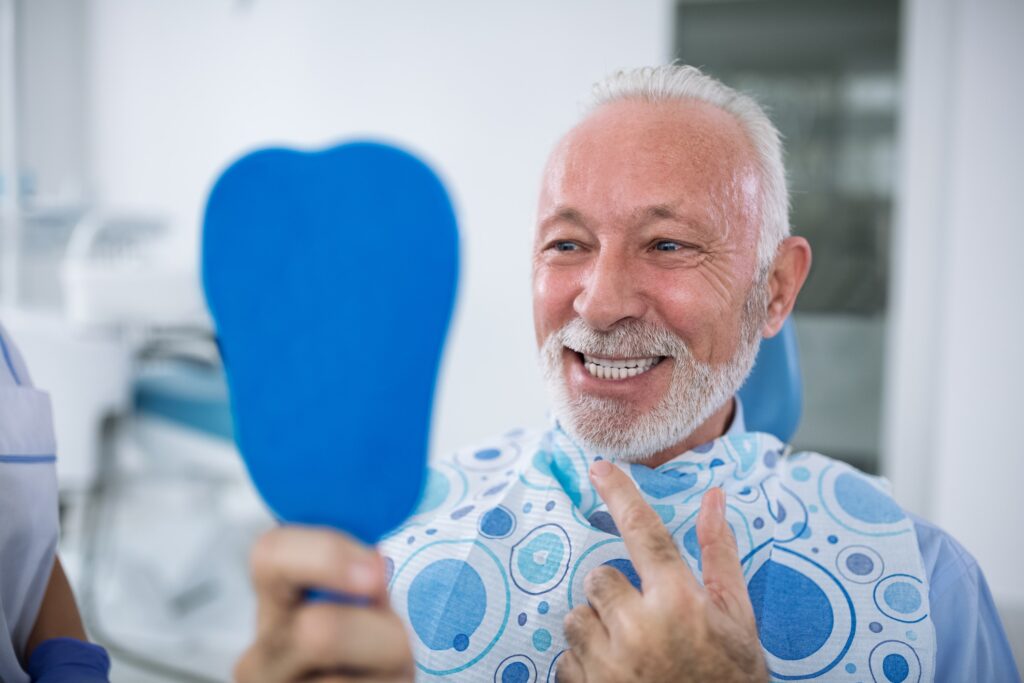
Medical literature shows that improving the general and oral health of the elderly requires understanding and addressing these obstacles [1] (Murali et al., 2025). Geriatric dentistry is a specialized branch of dentistry that addresses the unique oral health needs of aging adults. It addresses age-related problems such as medication-related dry mouth, receding gums, root decay, and complex dental restorations to help seniors maintain their natural bite and overall health.
The Hidden Link Between Gum Health and Brain Aging
For decades, doctors treated the mouth and the body as two separate systems. Today, we know that your oral health directly impacts your brain. As you get older, untreated gum disease becomes a serious medical risk. Clinical evidence links poor oral health to worse brain-health profiles on neuroimaging [2] (Rivier et al., 2023). The bacteria trapped in deep gum pockets act as a constant source of infection. Every time you chew, those bacteria enter your bloodstream. Recent clinical studies link these specific oral bacteria to cognitive decline, memory loss, and a higher risk of stroke. At Timber Family Dental, our preventive care does more than protect your smile. By keeping your gums free of inflammation, we actively help you protect your cardiovascular health and your mind.
Why Age Increases Your Need for Oral Cancer Screenings
Your risk for oral cancer increases significantly after age 55. Additionally, medical literature supports that oral cancer most often occurs in people over the age of 40 and affects more than twice as many men as women [3] (National Institute of Dental and Craniofacial Research, 2018). Even if you never smoked or used tobacco, decades of subtle environmental exposure take a toll on your cellular health. Unfortunately, oral cancer often develops silently, without any pain or obvious lumps in the early stages. You do not need to schedule a separate doctor’s appointment to get examined. We perform a fast, painless oral cancer screening during every routine exam. We examine your lips, tongue, cheeks, and throat for subtle color changes, abnormal tissues, or asymmetry. Spotting these silent signs early improves treatment success and gives you lasting peace of mind.
How to Eat Comfortably With Thinning Enamel
Your teeth work hard for you. After sixty or seventy years of daily chewing, your outer layer of enamel naturally wears down. As this protective shell gets thinner, the softer, highly sensitive inner layer of your tooth becomes exposed. You might find yourself suddenly wincing when you drink hot coffee or eat cold ice cream. You should not have to give up your favorite foods. If thinning enamel causes daily discomfort, we offer simple, non-invasive solutions. We apply professional-grade desensitizing varnishes that instantly plug the microscopic pores leading to your tooth nerves. This quick step restores your comfort so you can easily enjoy a meal out at your favorite Garner restaurants.
Comparisons: General Adult Care vs. Geriatric-Focused Care
Understanding how your dental needs shift in your senior years helps you seek the right level of support. Here is a breakdown based on Cost, Durability, and Maintenance Level.
Care Approach | Primary Focus | Cost Expectation | Durability (Health Outcome) | Maintenance Level |
Standard Adult Care | General prevention, simple fillings, and cosmetic maintenance. | Low (Standard insurance coverage). | Moderate (Assumes stable systemic health). | Low (Standard brushing and biannual visits). |
Geriatric-Focused Care | Managing dry mouth, root decay, and complex medical overlaps. | Moderate (Focuses on preserving aging dental work). | High (Extends the lifespan of natural teeth and old restorations). | Moderate (May require adaptive brushing tools at home). |
Reactive Senior Care | Waiting until a tooth breaks or an old crown falls out to visit the clinic. | High (Requires urgent extractions, implants, or new dentures). | Low (Accelerates jawbone loss and bite issues). | High (Requires complex surgical recovery and diet changes). |
Managing Shifting Teeth and Changes in Your Jaw
You might look in the mirror and notice your bottom teeth are suddenly crowding together. Many seniors are surprised when their teeth begin to shift, especially if they have had a straight smile throughout adulthood. Our jawbone naturally loses density as we get older. This gradual bone loss causes teeth to shift from their original positions. Your teeth fit tightly together, creating tight spaces a toothbrush cannot reach, causing decay. We track these subtle changes in bone and bite over time with 3D digital scanners. By catching these shifts early, we can adjust your bite alignment and keep your teeth easy to clean.
Coordinating Dental Visits for Aging Parents in Wake County
If you manage healthcare logistics for an aging parent, you already carry a heavy load. Coordinating multiple doctors, tracking prescriptions, and arranging transportation often feels exhausting. We remove the friction from your family’s dental visits. Our Garner clinic is designed for accessibility. We offer easy parking, ground-level access, and wheelchair-friendly treatment rooms. We prioritize prompt morning appointments so you do not have to disrupt your whole workday. Most importantly, we keep you in the loop. We invite you into the consultation room so you can hear our home-care advice firsthand. You get the clear communication you need to keep your parent’s health on track without the stress.
FAQs
1. What if I need clearance from my doctor before dental work?
If you have a history of heart murmurs, recent joint replacements, or cardiovascular surgery, we will handle the logistics. We coordinate directly with your primary care physician or Wake County specialist to ensure you receive the proper pre-medication antibiotics before your cleaning if needed.
2. Can my caregiver or adult child come into the treatment room with me?
Yes. We welcome caregivers and family members into the consultation room.
3. Are older dental fillings safe, or do they need to be replaced?
If you have metal fillings from decades ago, we do not replace them unless they are actively failing. We use low-radiation digital X-rays and high-definition cameras to inspect the edges of your old dental work. If they are secure, we leave them alone. If they are leaking or cracked, we gently upgrade them to durable, tooth-colored restorations.
References
[1] Murali, A., Muddappa, S. C., Rajan, R. R., Joseph, A., & Ravi, A. B. (2025). Barriers to Geriatric Oral Health: A Multifaceted Public Health Issue. Cureus, 17(8), e89604. https://doi.org/10.7759/cureus.89604
[2] Rivier, C. A., Renedo, D., de Havenon, A., Gill, T. M., Payabvash, S., Sheth, K. N., & Falcone, G. J. (2023). Poor Oral Health Is Associated with Worse Brain Imaging Profiles. medRxiv : the preprint server for health sciences, 2023.03.18.23287435. https://doi.org/10.1101/2023.03.18.23287435
[3] National Institute of Dental and Craniofacial Research. (2018, July). Oral cancer. Www.Nidcr.Nih.Gov. https://www.nidcr.nih.gov/health-info/oral-cancer