
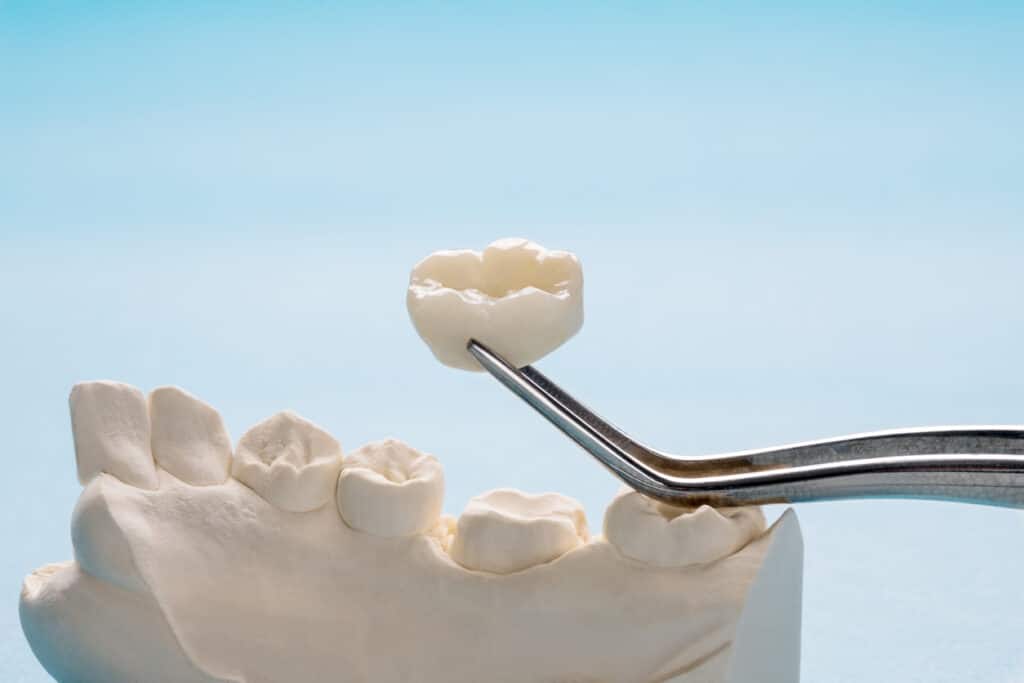
A clinical comparison of your restorative needs and crown material options: Porcelain crowns provide a lifelike look and are well tolerated by the body (“blend in” nicely with other teeth); they are suitable for visible front teeth. In fact, medical literature supports that Zirconia layered with a translucent ceramic, such as porcelain, is considered a more esthetic crown option [1] (Makhija et al., 2016). Meanwhile, metal alloy crowns withstand biting forces better and last longer, but they are best for out-of-sight back molars that absorb most chewing forces.
The Neutral Zone: Porcelain-Fused-to-Metal Crowns
Sometimes you want the strength of metal but the natural look of a white tooth. Porcelain-Fused-to-Metal (PFM) crowns are a dependable hybrid. Porcelain-Fused-to-Metal (PFM) crowns offer a reliable hybrid solution. For this restoration, we build a strong metal core and bake a tooth-colored ceramic layer right on top of it. This gives you excellent bite resistance while hiding the metal from view. However, PFM crowns do have a specific drawback. Because the materials are layered, the ceramic shell can eventually chip off the metal base if you bite down on hard objects like ice or hard candy. Notably, clinical literature supports that porcelain-fused-to-metal crowns have a higher 1 -2 year survival rate than metal crowns, but metal crowns have a higher survival rate at 4 years and after [2] (Carey et al., 2021).
Why Metal Crowns Save More of Your Natural Tooth
When you need a restoration, your goal should always be to keep as much of your natural tooth structure as possible. Because gold and metal alloys are exceptionally strong, dental labs can craft these crowns to be very thin. This means Dr. Byrd or Dr. Barbaro at Timber Family Dental only needs to shave away a tiny bit of your natural enamel to make the crown fit securely. Porcelain, on the other hand, requires a thicker cut to prevent the ceramic from cracking under daily chewing pressure. If your tooth is already heavily decayed, a thin metal crown might be the safest way to preserve your healthy root.
Teeth Grinding: Which Material Survives Bruxism?
If you wake up with frequent headaches or a sore jaw, you likely grind your teeth in your sleep. This subconscious habit is called bruxism, and it easily destroys standard dental work. Regular porcelain is stiff and will fracture under that heavy, repetitive stress. Gold and metal alloys absorb this nighttime pressure with ease. Better yet, metal wears down at the exact same rate as your natural enamel, meaning it will not damage the healthy teeth on the opposite side of your bite. If you grind your teeth but still want a white porcelain crown, a custom nightguard is essential to protect your investment. Medical evidence indicates that Zirconia-based crowns show high longevity in patients with bruxism, particularly when used with occlusal guards [3] (Gubrellay et al., 2025).
Comparisons: Porcelain vs. Metal Crowns
Understanding the mechanical differences between these materials helps you make a confident healthcare choice.
Material Attribute | All-Porcelain / Ceramic | Metal Alloy / Gold |
Bite Force Resistance | Moderate (Best for front and visible teeth). | Maximum (Best for heavy chewers and molars). |
Gumline Aesthetic | Excellent (No dark lines; reflects light naturally). | Poor (Silver or gold appearance; may show a dark margin over time). |
Temperature Transfer | Low (Acts as an insulator against hot/cold). | High (Conducts temperatures quickly to the tooth). |
Tooth Preparation | Requires more enamel removal to accommodate a thicker material. | Requires minimal enamel removal because of the material’s strength. |
Replacing Old Crowns: Saying Goodbye to the Dark Gumline
Many patients still have dental work from decades ago. If you have an older PFM crown, you might notice a dark shadow or gray line right where the tooth meets your gums. This cosmetic issue happens as your gum tissue naturally recedes over the years, exposing the metal rim underneath. If that dark line makes you feel self-conscious when you smile, we can safely remove the aging dental work. Upgrading to a modern all-ceramic or zirconia restoration eliminates the metal core, giving you a bright, flawless gumline once again.
Metal Allergies and Biocompatibility: What Goes Into Your Body
Your oral health is directly connected to your overall wellness. It is perfectly normal to care about the materials we place inside your mouth. While high-noble metals like gold are highly compatible with the human body, some older base-metal crowns contain nickel. These specific metals can irritate sensitive gums. If you have a history of skin allergies to certain jewelry, you may react to traditional dental metals. We care about your systemic health, which is why we offer 100% metal-free, biocompatible options such as pure zirconia. These state-of-the-art materials help keep your gums pink, healthy, and free of chronic inflammation.
FAQs
1. Will Your Porcelain Crown Change Color If You Drink Coffee or Red Wine?
No. Your natural tooth enamel is very porous and therefore stains. Dental porcelain is not porous. Your custom ceramic crown resists stains from coffee, tea, and wine and will stay bright for the life of the restoration.
2. Can I be allergic to a metal dental crown?
While rare, some patients do have mild sensitivities to specific base metals used in older crowns, such as nickel or beryllium. If you have a known metal allergy, inform our clinical team. We offer completely metal-free zirconia and all-porcelain options that are 100% biocompatible.
3. Why does my old metal-based crown have a dark gray line at the gums?
Older crowns were often constructed using a technique called “Porcelain-Fused-to-Metal” (PFM), which involved layering a ceramic coating over a metal shell. As you age, your gums naturally recede slightly, exposing the crown’s underlying metal rim. Upgrading to a modern, all-ceramic crown eliminates this dark line completely.
References
[1] Makhija, S. K., Lawson, N. C., Gilbert, G. H., Litaker, M. S., McClelland, J. A., Louis, D. R., Gordan, V. V., Pihlstrom, D. J., Meyerowitz, C., Mungia, R., McCracken, M. S., & National Dental PBRN Collaborative Group (2016). Dentist material selection for single-unit crowns: Findings from the National Dental Practice-Based Research Network. Journal of dentistry, 55, 40–47. https://doi.org/10.1016/j.jdent.2016.09.010
[2] Carey, C., Din, N. D., Lamb, J., Wright, H., Robb, N. D., & Abuzar, M. (2021). Survival of Single-Unit Porcelain-Fused-to-Metal (PFM) and Metal Crowns Placed by Students at an Australian University Dental Clinic over a Five-Year Period. Dentistry journal, 9(6), 60. https://doi.org/10.3390/dj9060060
[3] Gubrellay, P., Almudarris, B. A., Kumari, S., Jamadar, N. N., Alzahrani, K. M., Alyazaji, A. H., & Helal, D. A. A. (2025). Assessing the Longevity of Zirconia-Based Crowns in Bruxism Patients. Journal of pharmacy & bioallied sciences, 17(Suppl 2), S1162–S1164. https://doi.org/10.4103/jpbs.jpbs_1531_24