
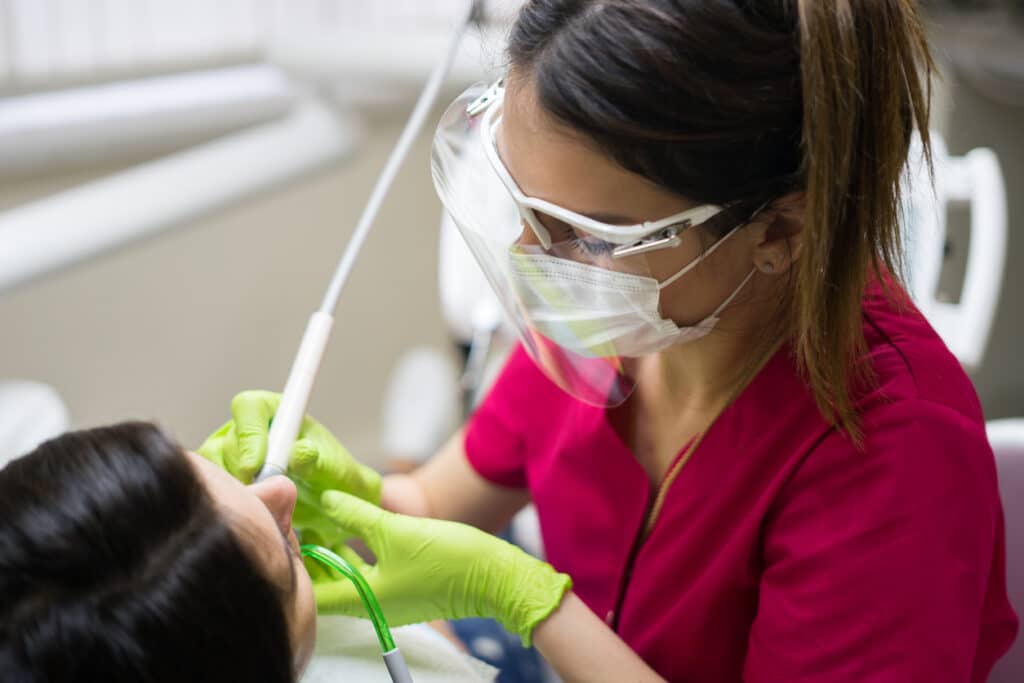
A deep teeth cleaning, or scaling and root planing, is a non-surgical periodontal treatment that safely removes hardened tartar from below your gum line. The medical literature defines treatment as scaling or polishing, or both, of the crown and root surfaces of teeth to remove local irritational factors [1] (Lamont et al., 2018). At Timber Family Dental, the average cost ranges from $150 to $300 per quadrant without insurance, though most PPO dental plans cover 50% to 80%.
4 Silent Signs You Need a Deep Teeth Cleaning
Gum disease rarely hurts in its early stages, which makes it easy to ignore. You might brush off a little sensitivity, but catching periodontal issues early prevents complex tooth loss later. If you experience any of these four warning signs, it is time to schedule an evaluation at Timber Family Dental:
- Bleeding gums: Your gums should never bleed when you brush or floss. Clinical literature indicates that the main signs of gingivitis are red, swollen, bleeding gums [2] (Informedhealth, 2023).
- Chronic Bad Breath: Also known as halitosis, a persistent bad taste or smell often indicates bacteria trapped deep below your gum line.
- Gum Recession: If your teeth suddenly look longer than they used to, it is because your gum tissue is actively pulling away from the root due to plaque buildup.
- Tenderness: Chewing swollen, puffy gums can make eating your favorite foods uncomfortable.
Advanced Tools for a Comfortable Procedure
The term “root planing” can sound scary. In our Garner clinic, we change that story with advanced clinical technology. In addition to traditional hand instruments, Dr. Barbaro uses ultrasonic scalers. The ultrasonic scaler uses a stream of water together with high-frequency vibrations. This technology comfortably shatters hard calculus deposits and flushes bacteria out of your deep gum pockets. Medical evidence supports that ultrasonic scaling is more effective at achieving microbiological and clinical criteria [3] (Oza et al., 2022). Because the ultrasonic tool does the heavy lifting, you experience far less physical scraping. This modern approach keeps your appointment fast, reduces your time in the chair, and ensures a highly comfortable experience.
Comparisons: Understanding Your Cleaning Options
Navigating your treatment plan is much easier when you understand the differences between cleaning types based on Cost, Durability, and Maintenance Level.
Service Type | Primary Purpose & Clinical Need | Cost Expectation | Durability (Care Lifespan) | Maintenance Level |
Standard Cleaning (Prophylaxis) | Routine plaque removal for healthy gums (pockets 3mm or less). | Low (Usually 100% covered by preventive insurance). | Moderate (Requires visits every 6 months). | Low (Daily brushing and flossing). |
Scaling & Root Planing (SRP) | Active treatment to stop bone loss and remove subgingival tartar. | Moderate ( 150− 150− 300+ per quadrant; 50-80% insurance coverage). | High (Halts active disease and resets gum health). | High (Requires transitioning to periodontal maintenance). |
Periodontal Maintenance | Ongoing, specialized cleanings after an SRP to prevent disease relapse. | Low to Moderate (Often partially covered by insurance). | High (Keeps deep pockets clean and stable for years). | Moderate (Requires visits every 3 to 4 months). |
What to Expect During Your Deep Cleaning Recovery
Patients often ask, “Will I be able to go back to work after my deep cleaning?” Yes, you can. Recovery is highly manageable. Because we use targeted anesthetics, your lips and gums will stay numb for a few hours after you leave our office. We recommend waiting to eat until the numbness fades so you do not accidentally bite your lip. For the first few days, you might experience mild sensitivity to hot or cold foods. Rinsing your mouth with warm salt water two to three times a day accelerates your healing and soothes your gum tissue. Continue to brush and floss at home, but use a soft-bristled toothbrush and apply gentle pressure until your gums feel completely normal again.
How Treating Gum Disease Protects Your Total Body Health
Your mouth is a direct gateway to the rest of your body. Investing in a deep cleaning does more than just save your teeth; it protects your overall wellness. When you have untreated gum disease, the deep pockets around your teeth act as open wounds. Every time you chew, harmful oral bacteria are pushed directly into your bloodstream. Clinical studies consistently link this specific bacterial inflammation to higher risks of cardiovascular disease, poorly controlled diabetes, and even pregnancy complications. By removing the hardened tartar and allowing your gums to seal back against your teeth, you cut off that bacterial gateway. A deep cleaning is a proactive step to protect your heart and your immune system.
Navigating Dental Insurance Codes for Periodontal Therapy
Understanding the specific language of dental insurance helps you avoid billing surprises. Deep cleanings are not billed like standard six-month checkups. When our administrative team files your claim, we use specific periodontal codes (like D4341 or D4342) depending on how many teeth in a specific quadrant require treatment. It is a “Basic” or “Major” restoration, not a preventive procedure, and is classified by insurance companies as such. Your insurance company will ask for clinical proof to approve your coverage. We take accurate pocket depth measurements and digital X-rays with low radiation during your exam. We deliver this exact data for you. This transparent process of documentation makes your insurance company aware of the medical necessity of your treatment to get the maximum reimbursement you deserve.
FAQs
1. Why is a deep cleaning billed by the quadrant?
Scaling and root planing takes significantly more time and precision than a standard cleaning. Treating the whole mouth at once can be overwhelming and requires too much numbing medication. Billing by the quadrant allows us to break your treatment into manageable, comfortable visits.
2. Does a deep cleaning hurt if my gums are already sensitive?
No. We prioritize your comfort above all else. Before we begin, we use advanced, gentle anesthetics to numb the treatment area. You will feel some pressure, but you should not feel any sharp pain during the procedure.
3. How often do I need a cleaning after scaling and root planing?
Once you complete a deep cleaning, you will transition to “Periodontal Maintenance.” Because gum disease can easily return, we will need to see you every three to four months to clean those deep pockets and ensure your gums remain healthy.
References
[1] Lamont, T., Worthington, H. V., Clarkson, J. E., & Beirne, P. V. (2018). Routine scale and polish for periodontal health in adults. The Cochrane database of systematic reviews, 12(12), CD004625. https://doi.org/10.1002/14651858.CD004625.pub5
[2] InformedHealth.org [Internet]. Cologne, Germany: Institute for Quality and Efficiency in Health Care (IQWiG); 2006-. Overview: Gingivitis and periodontitis. [Updated 2023 Aug 23]. Available from: https://www.ncbi.nlm.nih.gov/books/NBK279593/
[3] Oza, R. R., Sharma, V., Multani, P., Balsara, K., Bajaj, P., & Dhadse, P. (2022). Comparing the Effectiveness of Ultrasonic Instruments Over Manual Instruments for Scaling and Root Planing in Patients With Chronic Periodontitis: A Systematic Review and Meta-Analysis. Cureus, 14(11), e31463. https://doi.org/10.7759/cureus.31463