
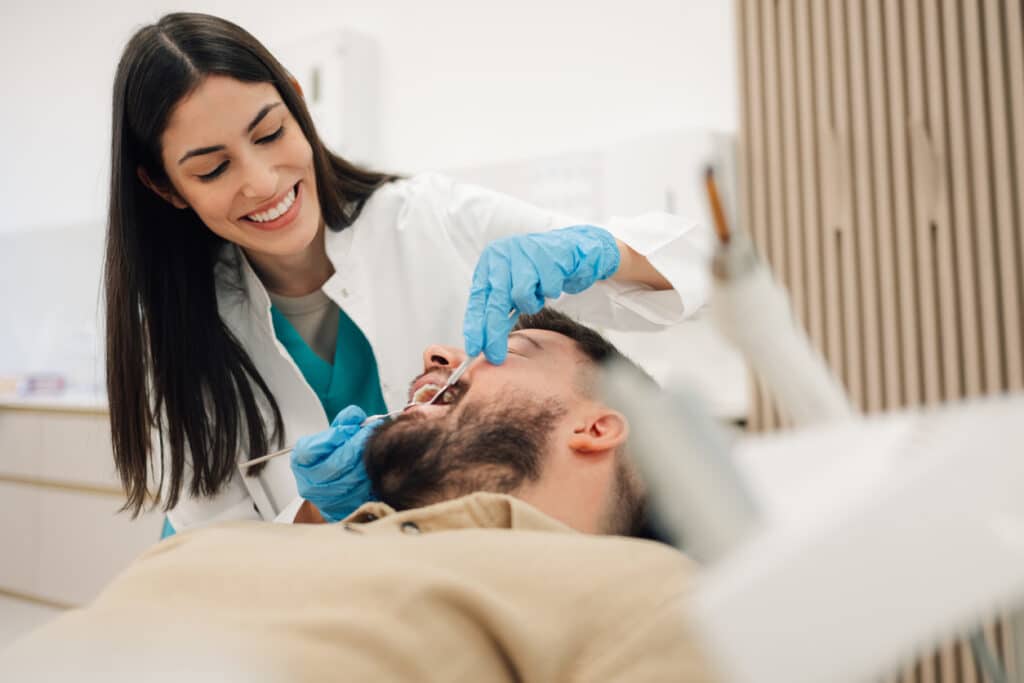
Dental pre-medication, or antibiotic prophylaxis, is a preventive clinical protocol consisting of the administration of antibiotics to specific patients prior to a dental procedure. Medical literature supports that Antibiotic prophylaxis in dentistry usually involves a single dose of antibiotics 30 min to 1 h before an invasive dental procedure [1] (Vidovic et al., 2024). Classically, prophylactic antibiotics reduce the risk of serious infection from routine cleanings in patients with vulnerable heart conditions, including artificial heart valves, or immunocompromised individuals.
Why Routine Cleanings Trigger the Need for Protection
You might wonder why you need antibiotics for a simple cleaning but not for a basic dental exam or X-rays. The answer comes down to the microscopic interactions in your gum tissue. During a visual exam, your dentist is examining your teeth. Nonetheless, professional cleanings require our hygienists to sweep away plaque along the gumline. Even with the gentlest techniques, this sweeping motion can create microscopic openings in the gum tissue. These tiny openings act as temporary entryways, allowing normal oral bacteria to enter small blood vessels in the bloodstream. For a healthy patient, this is harmless. But if you have a vulnerable heart valve, these bacteria can travel straight to your heart. Pre-medication acts as a biological shield, neutralizing the bacteria the exact moment they enter those temporary doorways.
Step-by-Step: Coordinating Your Medical Clearance in Wake County
Managing your own healthcare logistics often feels like a full-time job. If you recently had heart surgery or a complex joint replacement, you should not have to play phone tag between your dentist and your specialist. At Timber Family Dental, we simplify the medical clearance process to take that burden off of you. This is precisely how we handle your clearance behind the scenes:
- The first review: When you schedule your appointment, our front desk team reviews your medical history form for any red flags, such as recent surgeries or cardiac events.
- Specialist Coordination: If you need clearance, we contact your cardiologist or orthopedic surgeon directly, whether they are right here in Garner or at a WakeMed facility.
- The Prescription Transfer: Once your specialist confirms the protocol, we electronically send the exact required antibiotic prescription to your local pharmacy. All you have to do is pick it up and take it before you arrive.
Penicillin Allergies and Safe Antibiotic Alternatives
Safety is our top priority. The most common antibiotic prescribed for dental pre-medication is Amoxicillin. However, nearly 10% of patients report a penicillin allergy. If you are allergic to standard antibiotics, you do not have to skip your preventive dental care or risk an allergic reaction. Our clinical team carefully cross-references your allergy list before prescribing any medication. If you cannot take Amoxicillin, the American Heart Association outlines several safe, highly effective alternatives. We frequently prescribe Clindamycin, Azithromycin, or Cephalexin as substitutes. Medical literature supports that preprocedural antibiotic administration lowers the incidence of bacteremia; specifically, amoxicillin reduced the risk by 59%, azithromycin by 49%, and clindamycin by 11% [2] (Daley et al., 2026). These options provide the same level of bacterial protection for your heart and keep your visit safe and comfortable without causing allergies.
Comparisons: What You Need to Know Before You Go
Below is a breakdown of common patient protocols by preparation cost, health outcomes, and patient effort to prepare you for your next visit to our Garner clinic.
Preparation Protocol | Primary Purpose | Cost Expectation | Health Outcome (Durability) | Patient Effort (Maintenance Level) |
Standard Cleaning Prep | Routine preventive care for patients with no major medical conditions. | $0 | High (Maintains a healthy oral microbiome). | Low (Just show up and brush daily). |
Pre-Medication Protocol | Prevents bacteria from infecting vulnerable heart valves during dental work. | Low (Standard pharmacy copay for a single antibiotic dose). | High (Successfully prevents systemic infections and hospital stays). | Low (Take one pill 30 to 60 minutes prior to your visit). |
Medical Clearance | Requires your primary physician to formally approve dental care following a recent surgery or stroke. | $0 | Maximum (Ensures your body can handle local anesthetics and treatment stress). | Moderate (Requires coordination between our clinic and your Wake County doctor) |
After Your Appointment: Managing Your Single Dose
Unlike a standard antibiotic regimen that lasts for a week or more, dental pre-medication is usually a single, concentrated dose. Because you take a larger amount of medication all at once, you might experience mild, temporary stomach upset later in the day. We recommend taking a light, well-balanced meal before taking your pill to settle your stomach. It is a good idea to get a bite to eat at home or a smoothie near White Oak Crossing before your visit. You can also try a high-quality probiotic or a serving of yogurt the next day to help replenish your natural gut flora. By the next morning, the medication is fully out of your system, and your teeth are clean and protected.
The "Six-Month Rule": Why Updating Your File is Crucial
Your health is dynamic. A lot can change between your six-month dental checkups. You might have received a new pacemaker, undergone a knee replacement, or started a new blood-thinning medication. Because we only see you twice a year, your medical history form is our very first line of defense in keeping you safe. Never assume a medical event is “just a body issue” and not related to your teeth. Your oral health and your systemic health are permanently linked. We strongly encourage our patients to arrive five minutes early to their appointments to review their charts. By giving us a quick update on any new surgeries, hospital stays, or daily medications, you empower Dr. Byrd and Dr. Barbaro to tailor your treatment and ensure you receive the exact pre-medication protocol you deserve.
FAQs
1. Do I need antibiotics before a dental cleaning if I have a heart murmur?
In most cases, no. Decades ago, patients with simple heart murmurs or mitral valve prolapse were told to take antibiotics before the dentist. Current AHA guidelines confirm that these common conditions no longer require pre-medication. However, always update our team on any changes to your heart health so we can verify your status.
2. When exactly do I take the pre-medication pills?
You should take your prescribed dose 30 to 60 minutes before your scheduled appointment time. This gives the medication enough time to enter your bloodstream and reach peak effectiveness exactly when your cleaning begins.
3. What happens if I forget to take my antibiotic before I arrive?
Do not panic. If you forget to take your medication at home, let our front desk team know the moment you walk in. You can usually take the medication right away in our waiting room. Since the antibiotics take time to absorb, we may just delay the start of your cleaning by about 30 to 45 minutes to ensure you are fully protected.
References
[1] Vidović Juras, D., Škrinjar, I., Križnik, T., Andabak Rogulj, A., Lončar Brzak, B., Gabrić, D., Granić, M., Peroš, K., Šutej, I., & Ivanišević, A. (2024). Antibiotic Prophylaxis Prior to Dental Procedures. Dentistry journal, 12(11), 364. https://doi.org/10.3390/dj12110364
[2] Daley JO, Brizuela M. Antibiotic Prophylaxis in Dental and Oral Surgery Practice. [Updated 2026 Feb 18]. In: StatPearls [Internet]. Treasure Island (FL): StatPearls Publishing; 2026 Jan-. Available from: https://www.ncbi.nlm.nih.gov/books/NBK587360/